Category: Uncategorized

  • An American Story

    I came to America in 1975 and sensed immediately upon arrival that I had somehow stepped into the past.

    The skyscrapers in New York did indeed tower magnificently toward the sky, and broad sidewalks moved quickly under my feet while I jostled through the rushing crowds. Huge cars and yellow taxis careened, blaring their horns in blinding sunlight as the avenues met the streets at dangerous intersections. A wildness filled the air. NYPD officers stood at every corner, bulging revolvers slinging from their hips, ever ready in this never-ending frontier. But this wonderful city in the New World couldn’t hide from its past.

    European old-world ambiance, fixed in time, circled high above the skyline, frequently crashing down wildly and adrift some 3000 miles from home – when you’d hear snatches of Victorian speech from the gilded lobbies of hotels on Central Park South, Yiddish-speak from one-hundred-year-old Jewish delis on side streets, operatic voices and aromas out of old Italian establishments on the Upper East Side, Hiberno-English heard out of smoky half-door Irish bars from white-aproned barmen standing gaunt behind their mahogany counters, and guttural chatter from the beer halls of turn-of-century German-speaking immigrants along 86th Street.

    These sounds, senses, and aromas laced with toxic subway steam rose to meet the newcomer, the new immigrant, the uninitiated, reminding them of their past, their present, and the possibilities for their future. It was all on offer, and it came as a package – best opened slowly and carefully.

    What brought me to America was sudden and unexpected. I had been recruited as a nurse to a hospital in New Jersey, which had an acute nursing shortage at the time. The advertisement for nurses had appeared in the Irish Press, and out of curiosity, I applied. The quick response from the hospital flattered me, and I agreed to take the job. At 23, I had lived in London for two years, where the war in Northern Ireland loomed large in everyday social life and interaction. I wanted to leave. America sounded exciting, and I signed a two-year contract.

    It is my second day in New York, and the CEO from the hospital in New Jersey came to pick me up. I waited for him outside the Statler Hilton hotel on Seventh Ave, and he arrived at the curbside on time in a red Lincoln town car. This big man got out of his car on a beautiful sunny April morning in New York, while across the street, a row of cherry blossoms fluttered star-like through the pink sunlight.

    I almost laughed out loud. What could I possibly have to offer this important-looking man and his hospital that would go to all this trouble to bring me here? I was a little 5-foot-tall woman with just two years of post-graduate nursing experience. I felt they must have made a terrible mistake. But the man came over, greeted me warmly, and took me by the arm to his car. He took my beaten-up suitcase in his other hand and deposited me into the backseat of his Lincoln car, where I disappeared down into the white plush upholstery.

    After living in London, I found New Jersey to be a backwater. Suddenly, I’m in the heart of American suburbia, where the average citizen at the time had difficulty locating Ireland on a map and was mostly unaware of its history and politics. But I didn’t need to hide my Irish accent here, which I had often done in London to hide my identity. There was no time to hide anything at all here, as I quickly discovered I had just entered the belly of another beast.

    After a brief orientation to the hospital, I was assigned to the prison ward where sick men from the nearby penitentiary in Rahway were sent for medical care. I don’t know why hospital officials chose to assign me to this unit out of the 30 other Irish nurses, but they must have seen something in me, flattering or otherwise. I didn’t ask. Regardless, the prisoners loved my accent. Mostly, they didn’t seem to understand what I was saying, but they were all ears when I said it.

    The prison guards were friendly but carried guns. I felt frightened as they opened one cell door after another for me to enter to perform my duties for my imprisoned patients. The first morning I entered a cell and greeted the patient in the bed, I turned to see the guard with a drawn gun pointed at us. It shocked me as the patients were vulnerable and sick. But, as time passed, I came to accept it.

    After work and especially at night, I would often lie awake thinking of the prisoners’ grim existence. I thought of my mother back in 1958 in Cork, where we watched TV together as the newly elected Pope John XX111 visited Regina Coeli Prison on Christmas Day in Rome – bringing the prisoners gifts, consoling and cheering them on, and telling them not to despair. The old black and white TV screen of the new pope of peasant stock in 1958, embracing beaten-down prisoners, moved my mother to tears, as I, with my eight siblings, stood around her.

    Now in New Jersey, I couldn’t wait to go to work the next day and see these men in my care. I felt my mother did the rounds with me, a guiding force through the walls, temporarily offsetting the inhumanity of incarceration.  

    I volunteered to work in the prison ward for the next year. Its grimness seemed familiar ground – my mother struggling in 1950s Ireland with young children in poverty while admiring Pope John on TV and crying with him as he made his pilgrimage to the forgotten and disposable of society.

    I had indeed stepped into the past when I arrived in America, and I recognized it on my first day.

  • Sister Rosaleen

    1941-2021

    A biker ‘chick’ at 16, my cousin Ann O’Halloran went on to be a ‘warrior’ nun, fighting for the poor around the world – and even going on hunger strike in sympathy with Bobby Sands.

    MY first memory of Ann is seeing her clad in black leather, riding on the back of her boyfriend’s BSA bike while speeding past Cork City Hall. She was 16.

    It was the mid-1950s, and she was about as far away from a nun as you could imagine.

    But two years later, Sister Ann did indeed join holy orders.

    It was a decision that led to a remarkable career as a nun and teacher that earned her love and respect across the USA, South America and Africa.

    A passionate advocate of peace, Ann even riled parts of the establishment when she went on an 11-day hunger strike in support of dying IRA hunger striker Bobby Sands in 1981. Truly, she was a nun like no other…

    Ann O’Halloran was born in Cork city on July 6, 1941, one of six children, who included her brother John, the 1966 Cork All-Ireland winning hurler.

    Sr Rosaleen with her family including, from left, Michael, Mary, mother Ciss, father John, Rosemary, John Kevin, and Clare

    She joined the international Religious of the Sacred Heart of Mary (RSHM) in 1959 after graduating from the Marymount School in Neuilly, France, and was posted to a semi-cloistered order in Tarrytown, New York.

    Her timing was good. A year later, Pope John XXIII convened Vatican II and ordered the Church and religious orders to open their doors and go out as Jesus did to live among the poor. Ann needed no encouragement, at a time when civil rights and anti-war movements were rising up.

    She befriended the top New York journalists of their time, Pulitzer-winning Jimmy Breslin and Pete Hamill, both of whom had Irish roots. Through them, she met the Berrigan brothers, pacifist priests who led opposition to the Vietnam War.

    Ann joined them in organizing an escape from the Vietnam draft for young men, shepherding them to Canada and Mexico for safety. It was perilous work, with the FBI in pursuit, but Ann had her Order’s full support.

    She lived amongst the poor in Harlem, taught at parochial schools in the South Bronx, Manhattan, and Brooklyn, and lectured at Manhattan College.

    I picture her around that time, in the early 1970s, a petite, pretty 30-year-old. It is a hot summer’s evening and she is walking alone through the run-down streets of Harlem. Her worn blue shoes are flat, she’s dressed in a calf-length dark skirt and matching cotton jacket. Her hair is tucked under a soft, beige cloth cap pulled low on her forehead.

    Ann’s life work was simple: help, educate and empower the poor wherever she found them. She did that in New York, in the jungles of South America, and in Africa, carrying out the words of the RSHM Mission Statement: “The challenge of the gospel and the spirit of faith and zeal which marked our founding Sisters, urge us to respond to the needs of our time and to work with others in action for evangelical justice.”

    Under her adopted name Sister Rosaleen, Ann furthered her education. After receiving a BA degree from Marymount College and an MA in Anthropology from the New School for Social Research in New York, she volunteered to teach in South America.

    In 1964, Ann arrived, fluent in Spanish, at the Marymount School in the sprawling Colombian capital of Bogotá.

    It was a febrile time. The FARC revolutionaries had just formed into a military force and clashed openly with the Government and the Catholic Church’s teaching.

    Young Ann worked amid these social upheavals as an advocate for the poor around her. With the help of river guides, she and her religious colleagues frequently ventured by boat into the jungle interiors with food, water, and the Holy Eucharist to administer to fleeing civilians and rebels alike.

    They were perilous times in Colombia, religious personnel were targets for kidnappings, murder, and intimidation. In 1968, the RSHM order closed its Marymount Schools in the country, evacuating the nuns to the U.S.

    Back in New York, Ann resumed her educational ministry and taught in its dangerous, deprived neighborhoods. The people trusted and confided in her. She was invited into their lives and bore witness to their family celebrations, setbacks and despairs.

    She rallied prominent politicians, lawmakers, educators, journalists, captains of industry, and the Catholic hierarchy, to assist in her mission.

    She enlisted stakeholders across the spectrum of New York life. Restaurants donated food to the needy, politicians moved to better represent local people’s needs and opened job recruitment centers, educators offered scholarships for students, and journalists highlighted segregation as a poverty trap and a blot on New York’s good name.

    Ann also had the ear of Archbishop of New York, Cardinal Terence Cooke, whose Galway parents named him after Terence MacSwiney, martyr Lord Mayor of Cork. He sought her counsel on his pastoral reforming agenda to aid the city’s poor.

    Ann loved the spirit and resilience of Harlem’s black women. She told me of the poor mother who had rented furniture for an Easter weekend when her family visited from North Carolina. She wanted them to think she was doing well. The furniture would be returned next morning. When Ann asked her how she kept her spirits up in the face of such challenges, she replied: “Sister Rosaleen, I refuse to be unhappy.”

    It was that spirit that motivated Ann as she set up neighbourhood community centres focusing on adult education, drop-in food banks, after-school tutoring, counselling sessions, nutrition guidance, and small business start-ups.

    All this she did while teaching in New York’s parochial schools.

    Into Africa

    During Ann’s educational and social ministry in Harlem, she developed a strong bond with the African-American community. She had long wanted to work in Africa, and transferred to a teaching post in Dangamvura, Zimbabwe, from 1991 to 1994.

    Here, she taught large groups of women, giving them confidence to set up small businesses so they could feed and educate their kin.

    Initially, Ann had great hope for Zimbabwe under Robert Mugabe because of his close ties to Church and Irish missionaries in his youth. But, by 1991, he had abandoned his socialist ideology and violently formed a one-party state. It deeply saddened her.

    By 1994, Catholic religious groups were being targeted in remote rural outposts. Ann, now in her mid-50s, and her community of middle-aged nuns were attacked and robbed in their huts. Local women tended to them until help arrived.

    The RSHM had no choice but to evacuate the nuns. The Sisters were heartbroken to leave the local women and young children who depended on them, but Ann was not done with Zimbabwe.

    She had been diagnosed with early macular degeneration and was treated in New York and Ireland. Recharged, she continued her educational ministry in Africa. She told me they were some of the happiest years of her life.

    By 2016, her eyesight failing, Ann finally and sadly left Africa. Heartbreakingly, she totally lost her sight soon after and retired to the Marymount Convent in Tarrytown. She had ministered during some of the most socially and politically tumultuous decades in history and in some of the world’s most dangerous regions.

    In 2021, Ann was close to death. I left my home in Florida to see her one last time and entered her tiny, sparse room in the beautiful convent. She was sedated and comfortable. In a panic, I turned to Sr Francesca, her dear friend, and whispered: “What will I say to her?” She replied simply: “Ask her to say a prayer with you.”

    “Ann, it’s Breda,” I said, and I leaned over her. Her eyes shut, she flashed her broad smile, reached up and clasped both of my hands. “You’re very good to come,” she whispered. “Will we say a prayer together, Ann?” We started in union – ‘Our Father, who art in Heaven…”

    Ann died on November 7, 2021. She was a warrior – and her name was Sister Rosaleen. Ar dheis Dé go raibh a hanam dílis.

    Her Hunger Strike in solidarity with Sands

    ON May 2, 1981, a petite lady approaching her 40th birthday deftly put her shoe through the glass front door of the British Airways offices in Manhattan.

    This was all part of a series of protests by Ann O’Halloran – Sister Rosaleen – to draw attention in the U.S to the plight of Bobby Sands and his fellow hunger strikers in the Maze Prison in Northern Ireland.

    Ann went on an 11-day hunger strike outside the United Nations building in Manhattan in solidarity, and did a similar protest in Washington and an all-night vigil on the steps of St Patrick’s Cathedral in New York. TV camera crews followed her protests, which made headlines around the world.

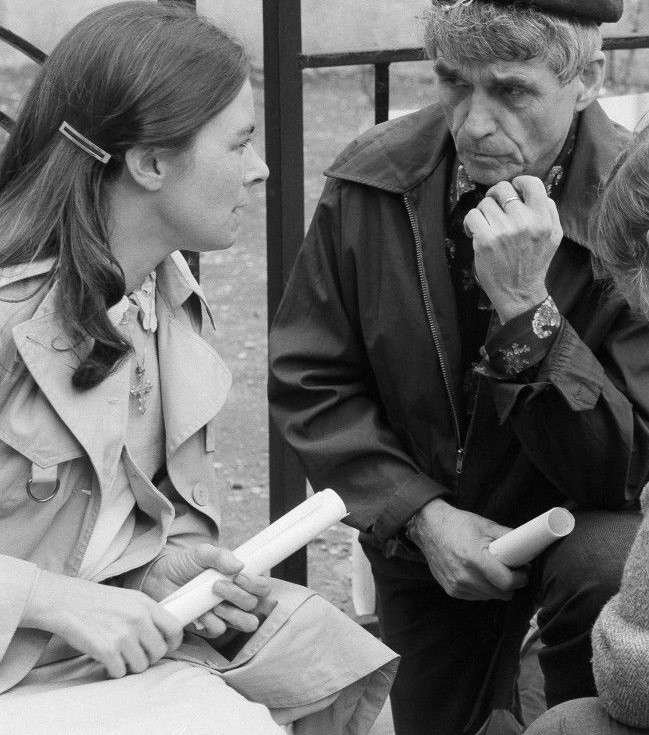
    Political activist and Jesuit priest, Father Daniel Berrigan talks with Sister Rosaleen O’Halloran in New York on April 30, 1981. She is on a hunger strike in support of caparisoned IRA guerrilla Bobby Sands since a rally at the United Nations in support of Sands. Sands was reported deteriorating at an alarming rate, and his mother has promised to let him die of starvation rather than compromise.  Date: 04/30/1981

    Sands eventually died on May 5, in a protest – which included the deaths of nine other hunger strikers – against the British removal of Special Category Status for IRA prisoners. The deaths attracted both praise and criticism and put the Troubles on the global map.

    On May 12, 1981, Ann carried out another public protest, when she rushed onto the stage at a charity dinner function for the Ireland Fund Awards in New York, and pleaded with the audience to recognize the “martyrdoms” of Sands and his fellow hungers strikers.

    The spotlight on the stage was shut off, but the nun resisted attempts to remove her and persisted to call for support for the hunger strikers, before being led away sobbing.

    Ann was passionate about starting a serious dialogue to bring about peace on her home island, and worked with other religious leaders toward a peaceful and just solution to the conflict.